
What Is an RRSP?
An RRSP lets you deduct contributions from your taxable income now and pay tax later, when you withdraw. Here is what it means, how it works step by step, how the refund and the rate of return work, and when an RRSP makes sense.
Get started free➜ Download the app➜
What Is an RRSP?
An RRSP, or Registered Retirement Savings Plan, is a Canadian account for retirement savings where contributions are deducted from your taxable income and investments grow tax-deferred. You pay income tax only when you withdraw, ideally in retirement at a lower rate. Room is 18% of last year's earned income, up to $33,810 for 2026.
What is an RRSP? The meaning and definition in plain language
An RRSP is a Registered Retirement Savings Plan: an account registered with the Canada Revenue Agency that is designed for retirement. Money you contribute is deducted from your income for tax purposes, which usually means a tax refund. The investments inside then grow without yearly tax, and you pay tax on what you take out later.
Like the TFSA, an RRSP is a wrapper rather than an investment. You can open one at a bank, credit union, brokerage or through a workplace group plan, and hold cash, GICs, bonds, mutual funds, ETFs or stocks inside it. People often call it an RRSP account, an RRSP plan or an RRSP savings account, but all three mean the same registered plan.
The core idea is tax deferral. You skip tax in your working years, when your income and tax rate are usually higher, and pay it in retirement, when income and tax rates are often lower. The difference between those two rates is the real benefit.
How does an RRSP work, step by step?
An RRSP works in four stages. You contribute up to your deduction limit, claim the contribution on your tax return to lower your taxable income, let the investments grow with no tax each year, and then withdraw in retirement, when each dollar taken out is taxed as income, usually at a lower rate than when you put it in.
- Earn room. Each year you file a return with earned income, the CRA adds new room: 18% of that income, up to the annual dollar limit. Your limit appears on your notice of assessment.
- Contribute. Deposit cash or transfer investments into your RRSP at any time during the year, or in the first 60 days of the next year for the previous tax year.
- Deduct. Claim the contribution on your return. Your taxable income falls by the amount deducted, which usually produces a refund or a smaller balance owing.
- Invest and grow. Interest, dividends and capital gains inside the plan are not taxed while they stay there.
- Withdraw or convert. Money you take out is added to your income that year. By the end of the year you turn 71 you must convert the plan to a RRIF, buy an annuity or cash it out.
How does the RRSP tax deduction and refund work?
An RRSP contribution lowers your taxable income dollar for dollar, so you save tax at your marginal rate, the combined federal and provincial rate on your last dollar of income. Someone with a 30% marginal rate who contributes $5,000 cuts their tax by about $1,500, which usually arrives as a refund after they file.
| Marginal tax rate | Tax saved | Real cost of the contribution |
|---|---|---|
| 20% | about $1,000 | about $4,000 |
| 30% | about $1,500 | about $3,500 |
| 40% | about $2,000 | about $3,000 |
| 50% | about $2,500 | about $2,500 |
Your marginal rate combines federal and provincial brackets; see tax brackets in Canada to find yours. The RRSP calculator estimates the refund for your income and province, and our guide to the tax refund in Canada explains when it arrives.
The refund is not free money. It is tax deferred, and it is repaid when you withdraw. Reinvesting the refund, rather than spending it, is what makes an RRSP work as intended.
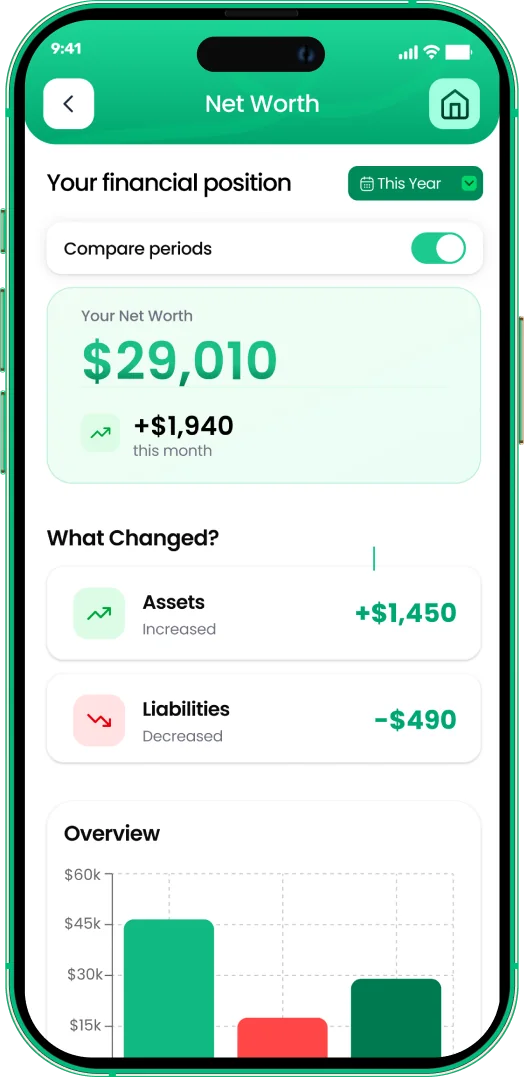
Watch your net worth grow
- Add assets and debts in any of 148 currencies
- See what changed month by month
- Set savings goals and track progress


What is the rate of return on an RRSP?
An RRSP has no rate of return of its own. Your return depends entirely on what you hold inside it: a high-interest savings option or GIC pays its stated rate, while funds, ETFs and stocks rise and fall with markets. The RRSP adds a tax advantage on top of that return, not a guaranteed rate.
Because nothing is taxed while it stays in the plan, the full return compounds every year. The table shows how $5,000 a year grows over 25 years at three assumed annual returns. These are illustrations, not forecasts.
| Assumed annual return | Value after 25 years | Growth on top of contributions |
|---|---|---|
| 3% | about $182,300 | about $57,300 |
| 5% | about $238,600 | about $113,600 |
| 7% | about $316,200 | about $191,200 |
Worked example: the after-tax return
Take $1,000 of salary and a 5% return for 25 years, which multiplies money by about 3.386. In an RRSP, the full $1,000 is invested and grows to about $3,386. If your tax rate is 30% at withdrawal, you keep about $2,370. If you had paid 30% tax first and invested the remaining $700 in a TFSA, you would also have about $2,370. With equal tax rates the two accounts tie.
Why a lower retirement tax rate matters
If your rate in retirement is 20% instead of 30%, the same RRSP withdrawal leaves you about $2,709, roughly $339 more than the TFSA. That gap, not the refund itself, is the true extra return of an RRSP. Model your own numbers with the compound interest calculator.
How much can you contribute to an RRSP?
Your RRSP room for a year is 18% of your previous year's earned income, up to an annual dollar maximum of $33,810 for 2026, minus any pension adjustment if you belong to a workplace pension plan. Unused room carries forward indefinitely. Your exact figure appears on your notice of assessment and in your CRA account.
- Earned income includes employment and self-employment income and net rental income, but not investment income or most government benefits.
- Over-contribution buffer. You can go up to $2,000 over your limit without penalty. Beyond that, a tax of 1% per month applies to the excess.
- Deadline. Contributions made in the first 60 days of a year can count toward the previous tax year. See the RRSP deadline for the current date.
- Deduction timing. You can contribute now and carry the deduction forward to a year when your income, and your refund, will be higher.
The dollar limit rises with average wages and is already set at $35,390 for 2027. For every year's limit and how a pension adjustment works, see our page on the RRSP contribution limit.
Who is eligible to open an RRSP?
Anyone with earned income who files a Canadian tax return builds RRSP room, and you can contribute until the end of the year you turn 71. The tax rules set no minimum age, so a teenager with a part-time job earns room too, though some providers require you to be an adult to open an account.
- No income, no new room. Years with no earned income add no room, but past unused room stays available.
- Spousal RRSP. You can use your own room to contribute to a plan for your spouse or common-law partner, even after you turn 71 if they are younger.
- Newcomers. Room starts the year after your first Canadian earned income, once you have filed a return.
What happens when you withdraw from an RRSP?
Withdrawals are added to your income and taxed at your marginal rate that year. Your financial institution withholds tax at source, as shown below, and the final tax is settled on your return, so you may owe more or get some back. Except under the Home Buyers' Plan and Lifelong Learning Plan, the room used is gone for good.
| Amount withdrawn | Outside Quebec | In Quebec (federal only) |
|---|---|---|
| Up to $5,000 | 10% | 5% |
| $5,001 to $15,000 | 20% | 10% |
| Over $15,000 | 30% | 15% |
Worked example: someone in Manitoba with a 30% marginal rate withdraws $10,000. The bank withholds 20%, or $2,000, and pays them $8,000. On their return the withdrawal is taxed at about $3,000, so they owe roughly $1,000 more in April. Splitting a withdrawal into smaller pieces lowers the withholding but not the final tax. The RRSP calculator shows the tax on a withdrawal at your income.
Quebec residents also have provincial tax withheld. Figures checked October 2026; confirm current amounts with the Canada Revenue Agency.
Home Buyers' Plan
First-time buyers can withdraw up to $60,000 from an RRSP tax-free to buy a qualifying home, then repay it over 15 years. For a first withdrawal made from 2022 to 2028, repayments start in the fifth year after the withdrawal instead of the second. Missed repayments are added to your income. Many buyers now pair this with an FHSA.
Lifelong Learning Plan
You can withdraw up to $10,000 a year, and $20,000 in total per participation period, to pay for full-time education or training for you or your spouse, then repay it over a period of generally 10 years.
Converting at 71
By the end of the year you turn 71, you must close your RRSP by converting it to a Registered Retirement Income Fund (RRIF), buying an annuity or withdrawing it as taxable cash. A RRIF requires a minimum withdrawal each year, which also counts as taxable income.
What are the benefits of an RRSP, and the drawbacks?
The main benefits of an RRSP are an immediate tax deduction at your marginal rate, tax-free compounding while money stays inside, and the chance to pay less tax by withdrawing in lower-income years. The main drawbacks are that every withdrawal is taxable, the room used is lost, and large withdrawals in retirement can reduce income-tested benefits.
- Benefit: bigger refunds at higher incomes. The higher your bracket, the more each dollar contributed saves.
- Benefit: employer matching. A group RRSP match is an immediate return you get nowhere else.
- Benefit: home and education access. The HBP and LLP let you borrow from yourself tax-free.
- Benefit: income splitting. A spousal RRSP can even out retirement incomes in a couple.
- Drawback: taxable withdrawals. Early withdrawals for emergencies are taxed and the room never returns, which is why an emergency fund usually belongs in a TFSA or savings account.
- Drawback: benefit clawbacks. Large RRIF withdrawals can reduce Old Age Security and the Guaranteed Income Supplement.
RRSP vs TFSA vs FHSA: which account for which goal?
Use an RRSP for retirement when your tax rate today is higher than you expect it to be later, a TFSA for flexible goals or when your income is modest, and an FHSA if you are saving for a first home. Many Canadians use more than one, filling the account that gives the biggest benefit for each goal first.
| Account | Deduction on deposits | Tax on withdrawals | Best suited to |
|---|---|---|---|
| RRSP | Yes | Taxed as income | Retirement, especially at middle and higher incomes |
| TFSA | No | None | Flexible goals and lower incomes |
| FHSA | Yes | None, if used for a first home | Buying a first home |
If you are saving for a first home, the FHSA combines the RRSP's deduction with tax-free withdrawals. Compare the two retirement options with your own numbers in the TFSA vs RRSP calculator.
How to start an RRSP for retirement and build the habit
- Check your contribution room on your latest notice of assessment or in your CRA account.
- Ask your employer about a group RRSP. Matching contributions are an instant return worth taking in full.
- Open an RRSP at a bank, credit union or brokerage and choose investments that fit your timeline and risk comfort.
- Set up an automatic contribution each payday so saving happens before spending. EMOH Pay's savings goals and budgets show the contribution as a planned line each month.
- Reinvest or save your tax refund, and estimate how much you need with the retirement savings calculator and our guide to saving for retirement in Canada. More guides are on our money guides hub.
Your net worth in EMOH Pay
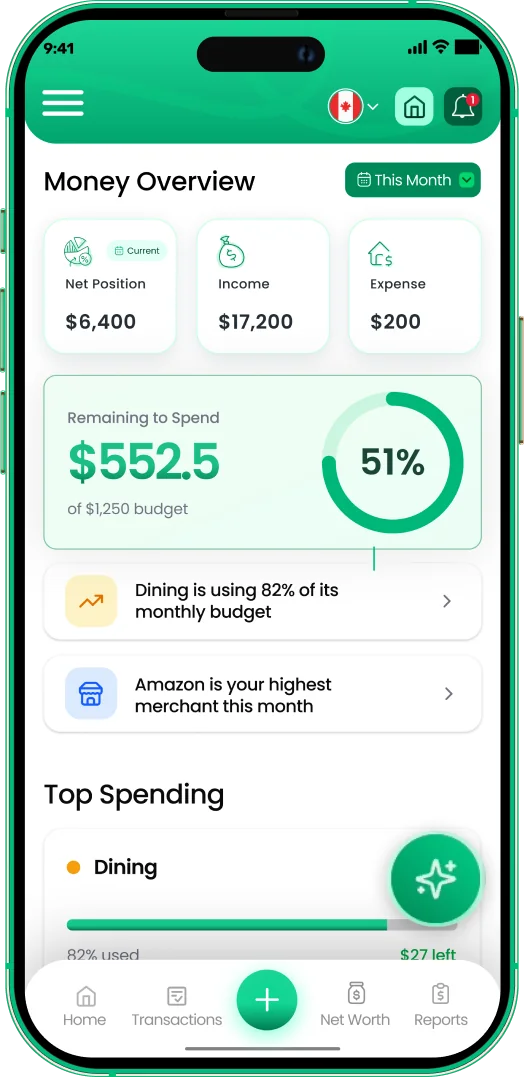

Put the numbers on autopilot
EMOH Pay tracks your spending, budgets and net worth on your phone and in the browser, always in sync. Free to start, made in Canada.
Get started free➜What Is an RRSP?: frequently asked questions
What does RRSP stand for?
RRSP stands for Registered Retirement Savings Plan. It is registered with the Canada Revenue Agency, which is what gives it its tax deduction and tax-deferred growth.
Is an RRSP worth it?
It usually is if your tax rate today is higher than you expect in retirement, or if your employer matches contributions. At low incomes a TFSA is often better, because the refund is small and RRSP withdrawals later can reduce income-tested benefits.
Can I withdraw from my RRSP at any time?
Yes, but the withdrawal is taxed as income, tax is withheld at source and the contribution room is lost for good. The Home Buyers' Plan and Lifelong Learning Plan are the main exceptions, as long as you repay on schedule.
How much tax will I get back from an RRSP contribution?
Roughly your contribution multiplied by your marginal tax rate. A $5,000 contribution at a 30% marginal rate saves about $1,500. The refund can be smaller if your deduction drops you into a lower bracket partway through.
What are the main RRSP rules?
Contribute only up to your deduction limit plus the $2,000 buffer, claim receipts on your return, expect tax on every withdrawal, and close or convert the plan by the end of the year you turn 71.
What is a spousal RRSP?
A spousal RRSP is one you contribute to for your spouse or common-law partner, using your own room and getting the deduction yourself. Withdrawals in retirement are generally taxed in their hands, which can split income and lower the household's total tax.
Do I need an RRSP if I have a workplace pension?
Not always. A pension adjustment reduces your RRSP room, so you may have less to contribute. Many people with pensions still use an RRSP for extra savings, or a TFSA if their retirement income will be high. EMOH Pay's net worth view shows all your accounts together.
Does an RRSP guarantee a return?
No. The return depends on the investments inside it. GICs and savings options pay a stated rate, while funds and stocks can rise or fall. The RRSP only changes when and how the return is taxed.
Related guides and tools
Free RRSP calculator for 2026: see the tax refund on your contribution, what it really costs after tax, your new room and…
RRSP Contribution Limit 2026The RRSP contribution limit for 2026 is 18% of your 2025 earned income, up to $33,810. See CRA limits by year, how room…
TFSA vs RRSP CalculatorTFSA vs RRSP: compare your tax rate today with your expected rate in retirement and see which account leaves you with more…
RRSP Deadline 2026The RRSP deadline 2026 for 2025 contributions was 2 March 2026; the next is 1 March 2027. See how the 60-day rule works…
What Is a TFSA?What is a TFSA? A plain-language definition of Canada's Tax-Free Savings Account: how it works, what you can hold…
What Is an FHSA?What is an FHSA? A plain-language guide to Canada's First Home Savings Account: who qualifies, the $8,000 yearly limit…
Start free today
Free on iPhone, Android and the web. Upgrade to EMOH Pro anytime for advanced AI and unlimited family sharing.
Download for iOS➜ Get it on Android➜